



S-BEAR Gear Materials
Select by lubrication,
temperature and service life.
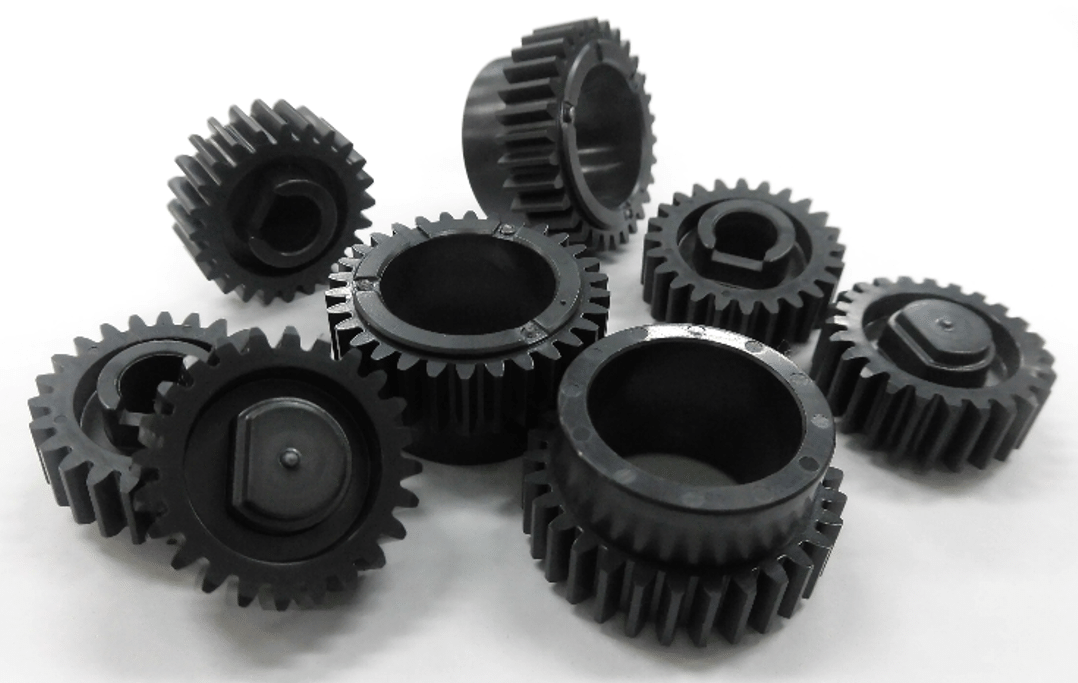
Tooth wear, meshing heat and cyclic loads affect polymer gear durability. S-BEAR is a series of high-performance materials for injection molding, with proprietary formulations to support longer service life, grease-free operation and lightweight design.
Beyond the base polymer:
formulations designed for gears.
Even with the same PPS or PEEK base polymer, gear performance varies with formulation and operating conditions. S-BEAR grades build on base-polymer properties while addressing friction, wear and cyclic loading.
Reduce wear.
Extend service life.
Consider tooth flank wear and tooth root fatigue. Check gear load capacity to identify materials suited to the required service life.
Consider
grease-free operation
Self-lubricating grades can be evaluated where lubricants are difficult to use or where application and replenishment need to be reduced.
For less squeal
and meshing noise
Review material properties and the mating gear combination to address noise alongside wear.
Replace metal.
Review gear face width.
Select materials with the required load capacity to evaluate weight reduction through polymer replacement and the potential to reduce gear face width.
S-BEAR is a material brand. We select grades for applications ranging from unlubricated to grease-lubricated conditions. Suitability depends on the grade and operating conditions.
Select materials by lubrication
and performance requirements.
Start with grease use, mating gear material, temperature, torque and rotational speed. The main gear grades are introduced below. Other materials can also be proposed for your application and operating conditions.
Material selection differs between applications prioritizing unlubricated sliding performance and those requiring high durability with grease lubrication.
For gears requiring
high load capacity
A PPS-based material developed with grease-lubricated gear durability in mind. When considering replacement of metal gears or PEEK-based materials, we compare durability, gear geometry, planned production volume and cost.
- Focus on gear load capacity with grease lubrication
- Adopted in the LOVOT family robot
- Material changes reviewed against operating conditions
Consider the
mating gear combination
Self-lubricating, PPS-based heat-resistant gear grades. S2110 is considered where effects on the mating gear need to be limited. S4815 can be evaluated in combination with S2110 for reduced wear.
- Candidates for grease-free operation
- Considered for idler gears and other applications
- Wear characteristics evaluated as a gear pair
Heat resistance
and low wear
A PEEK-based gear grade offering high load capacity and wear resistance. Its reduced tendency to squeal without lubrication can be considered for high-load, low-noise gears.
- Candidate for heat- and wear-resistant applications
- Squeal control without lubrication
- Suitability evaluated against load and temperature
Other Materials for Specific Applications
For gears where load capacity and wear resistance near room temperature are priorities.
Material example: A2060For mechanisms requiring room-temperature load capacity while limiting the effects of water absorption.
Material example: N4095For applications where heat-resistant materials are evaluated against the operating temperature.
Material example: S3100For mechanisms where gear materials need to be evaluated for large torque loads at startup.
Material example: S4735Consider thermoset resin characteristics for components exposed to abnormal temperature rises.
Material example: P4340Developing gear materials
for longer unlubricated service.
Reduce the replacement frequency of POM and other polymer gears. Replace metal gears with lighter, grease-free designs. These challenges guide our development of high-durability materials.
X2001:
Longer Life & Grease-Free Operation
In unlubricated tests using same-material gear pairs, development grade X2001 achieved more revolutions to failure than the comparison polymers. We use these results to evaluate longer replacement intervals and changes to gear face width against required life and loads.
X2001 is a development material. Please discuss suitability, supply specifications and evaluation conditions for your application with us.
- 01Longer Service LifeEvaluate material changes from POM and other gear materials to reduce replacement frequency.
- 02Grease-Free OperationEvaluate gear durability without lubrication when considering lubricant-free designs.
- 03Slimmer, Lighter DesignsReview the potential to reduce gear face width while meeting required service life and load capacity.
Compare material durability under the same test conditions.
The X2001 data compare same-material gear pairs without lubrication. These conditions differ from grease-lubricated tests for grades such as S1860. Use the results that correspond to the intended operating conditions.
Evaluate material properties
and durability in gear meshing.
Selecting materials by flexural strength or modulus alone may not achieve the required service life. Cyclic loading, wear, heat generation and the mating material also need to be considered.
Flexural strength and
gear load capacity are different.
Flexural strength describes a test specimen's mechanical behavior. Repeated gear meshing also requires evaluation of fatigue and tooth flank wear. STARLITE uses material-specific gear load capacity curves to support selection.
Our catalog includes an example in which glass-fiber-reinforced POM had higher flexural strength but lower gear load capacity than unfilled POM in tests using same-material gear pairs.
Lubrication & Mating Gear
Review unlubricated, grease-, oil- or water-lubricated conditions, together with gear pairs using the same polymer, different polymers or metal.
Loads & Duty Cycles
Check steady torque as well as starting, stopping, reversing and impact loads. Evaluate fatigue characteristics against the required service life.
Temperature & Dimensional Change
Consider ambient temperature and operating heat. Review water absorption, thermal expansion and their effects on dimensions and backlash.
Geometry & Molding Conditions
Review gear face width, module and tooth root geometry together with molding shrinkage, fiber orientation and weld lines.
For gear design, analysis and drive unit development, see Actuator & Drive Unit Development (Japanese) →
Discuss gear wear, service life
and lubrication with us.
You do not need to finalize every material or specification before contacting us. We can review S-BEAR applicability based on the operating conditions you know and the issues you want to improve.
To share drawings, photos or specifications, email tech-info@starlite.co.jp directly.
Please include your company name, contact details, application and the issue you would like to discuss.
- ApplicationEquipment / Current material / Wear, failure or noise / Improvement goals
- OperationTorque / Speed / Start-stop cycles / Operating time / Required life
- EnvironmentTemperature / Lubrication / Mating gear material / Water or chemicals
- Gear & VolumeDrawing / Module / Tooth count / Face width / Planned volume