



STARLITE SEALING SOLUTIONS
Polymer Seal Material Selection & Design Support
For leakage, wear and shaft-damage challenges.
Combining materials, component geometry, processing and evaluation for your operating conditions.
SEALING SOLUTIONS
Address Leakage, Wear and Maintenance Together
Seal selection involves more than controlling leakage. Seal wear, effects on the mating shaft, heat generation and replacement intervals also need to be considered.
STARLITE reviews materials, component geometry and manufacturing methods for polymer seals used in compressors, rotating shafts, office equipment and other applications. We combine expertise in material design, molding, machining and evaluation to support both existing-component improvements and new-component development.
Key Conditions for Polymer Seal Selection
Material names alone do not determine suitability. We review the media, temperature, pressure, motion, mating material and other operating conditions.
Scroll horizontally to view the full table.
| Challenge | Key Conditions to Review | Areas for Review |
|---|---|---|
| Reduce leakage | Media, pressure differential, temperature, clearance and allowable leakage | Material, geometry and dimensions |
| Reduce wear and shaft damage | Mating material, surface roughness, speed, contact conditions and lubrication | Material selection and contact conditions |
| Accommodate temperature changes | Operating temperature, temperature variation and differences in thermal expansion | Materials and geometry considering dimensional change |
| Operate in chemicals or gases | Media type, concentration, moisture content, temperature and pressure | Material candidates for the operating environment |
| Produce large-diameter or long components | Dimensions, geometry, required tolerances, split construction and assembly method | Manufacturing options, including molding and machining |
| Consider series production or part integration | Production volume, dimensional tolerances, mating components and molding method | Injection molding and insert molding |
Material and seal-type suitability must be assessed against the combination of operating conditions. You can discuss your application with us even if some conditions have not yet been finalized.
GAS COMPRESSORS / ALP
Gas Seals for Compressors
Reviewing gas type and operating conditions to select materials for wear, leakage and dimensional-change requirements.
For piston rings, rider rings and rod packing in reciprocating gas compressors, gas type, pressure, temperature, moisture content and sliding conditions are important material-selection factors. We review suitable candidates from ALP, STARLITE's PTFE-based material series, according to the operating environment.
Typical Challenges
- Premature wear and frequent replacement
- Damage to mating components or deformation of seal parts
- A need to review materials following changes in gas or operating conditions
What We Can Discuss
- Material selection for the gas atmosphere
- Ring materials and designs considering wear resistance and effects on the counterface
- Material and geometry reviews informed by the condition of used components


Inspection and analysis of used components are reviewed within the scope of improvement proposals using STARLITE's materials, processing and evaluation technologies.
ROTATING SHAFTS / ALP
PTFE Lip Seals for Rotating Shafts
For applications where leakage, shaft wear, sliding resistance and replacement intervals need to be reviewed together.
ALP lip seals use the low-friction and wear-resistant properties of PTFE-based materials for rotating-shaft sealing. For pumps, agitators and other industrial equipment, we review the liquid, temperature, pressure, rotational speed, shaft material and surface condition to consider suitable materials and lip geometry.
Typical Challenges
- Seal or shaft wear leads to frequent repair and replacement
- Heat generation and sliding resistance also need to be addressed
- The current seal has service-life or installation-space limitations
What We Can Discuss
- Rotating-shaft seals used in liquids
- Materials and lip geometry considering effects on the mating shaft
- Options for replacing an existing seal
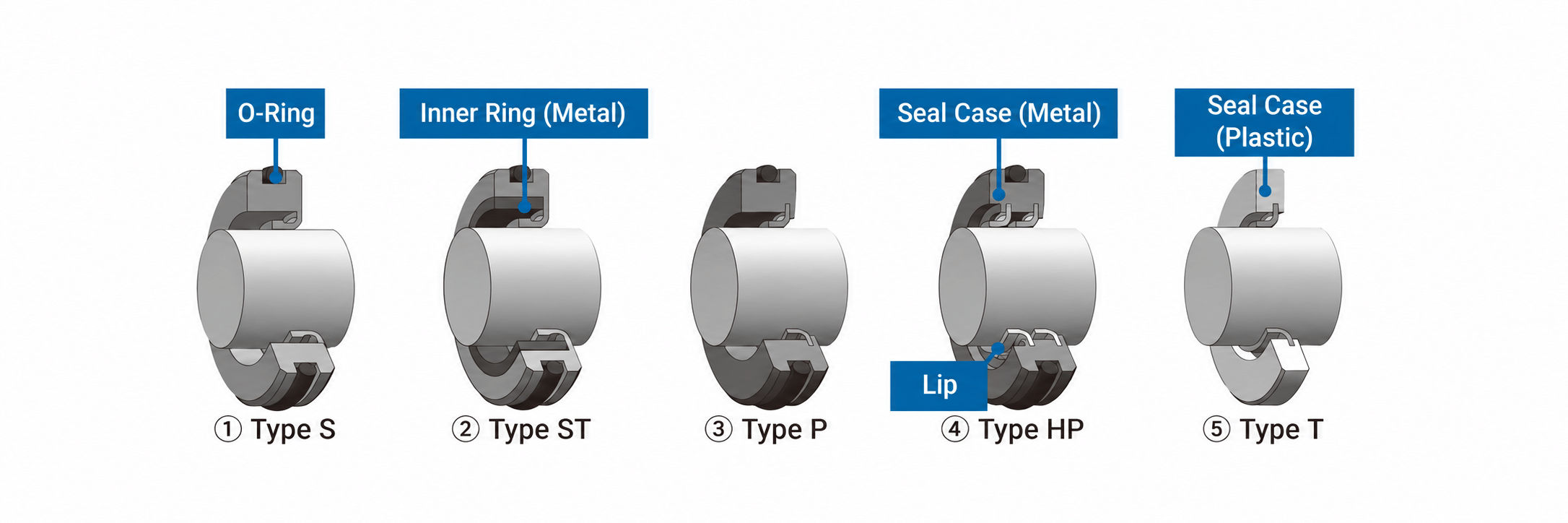
View Lip Seal Types and Specifications
Scroll horizontally to view the full table.
| Type | Construction / Features | Allowable Pressure MPa | Allowable Speed Oil-Lubricated / m/s | Allowable Speed Unlubricated / m/s |
|---|---|---|---|---|
| S | Standard lip seal type | 0.5 | 60 | 10* |
| ST | Metal inner ring helps limit dimensional change caused by temperature variation | 0.5 | 60 | 10* |
| P | Metal seal case helps limit lip deformation | 1.0 | 60 | 10* |
| HP | Double-lip construction based on the P type | 4.5 | 60 | 10* |
| T | Standard product with the seal case and lip integrated by injection molding Shaft diameters: φ5, φ6, φ8 | — | — | 0.5 |
*: Value for a shaft diameter of φ90.
Suitability is assessed against temperature, pressure, speed, process fluid, lubrication, mating shaft and other operating conditions. Please contact us to review combinations of the pressure and speed values shown, as well as conditions marked with a dash (—).
Concerned About Wear Debris from Agitator Seals?
Explore a case study on reviewing material selection and contact conditions to address both service life and wear-debris reduction.
View the Agitator Seal Case Study (Japanese)OFFICE EQUIPMENT / S-BEAR
Toner Seals for Office Equipment
Reviewing wear resistance, dimensional accuracy and series production for components used around toner powders.
Toner leakage, seal wear debris and dimensional variation can affect internal cleanliness and print quality. Using S-BEAR high-performance materials for injection molding, STARLITE combines material design, precision tooling and precision injection molding to review compact, high-precision components.
Typical Challenges
- Reduce toner leakage and wear debris
- Fit components into limited installation space
- Reduce dimensional variation and assembly workload in series production
What We Can Discuss
- Material selection considering wear in powder environments
- Series-produced components made by precision injection molding
- Insert molding and part integration according to the specifications
LARGE-DIAMETER & LONG COMPONENTS
Large-Diameter Seals and Long Sliding Components
Reviewing materials, molding and machining options for dimensional and geometry constraints.
For rings and long sliding components in large equipment, the review extends beyond material properties to warpage, dimensional accuracy, steps at split joints and assembly methods. We combine material-design, molding and machining expertise to consider manufacturing methods suited to the required dimensions and geometry.
Typical Challenges
- Find a supplier for molding or machining large-diameter components
- Address leakage, steps or misalignment at split joints
- Review warpage, dimensional accuracy and replacement work for long components
Key Review Points
- Material, dimensions, geometry, required tolerances and quantity
- Split, joined or integrated construction
- Assembly methods and interfaces with mating components
Available dimensions, construction and quantities depend on the material and required specifications. Large-diameter seals and long sliding components are assessed separately according to their functions and operating conditions.
CRYOGENIC DESIGN & EVALUATION
Materials, Geometry and Evaluation for Cryogenic Service
Reviewing thermal contraction and clearance changes to support seal-design decisions.
Under cryogenic conditions, changes in polymer properties and differences in thermal contraction between polymers and metals can alter the contact conditions established at room temperature. STARLITE uses evaluation capabilities at room temperature and −196°C to support material and component-geometry reviews.
Review Each Evaluation Method and Its Conditions
Friction and wear testing and helium-gas seal testing evaluate different aspects of performance under different test conditions. Applicability to the actual media, temperature and pressure, as well as the need for additional evaluation, is reviewed individually.
Explore Cryogenic Design and Evaluation CapabilitiesFrom Operating Conditions to Material and Specification Reviews
You can discuss the issue and operating conditions with us before material candidates are finalized. Depending on the project, we review the following items.
Review the Application and Conditions
Confirm the media, temperature, pressure, motion, mating material, dimensions and issues with the current component.
Review Materials, Geometry and Processing
Consider candidate materials, component geometry, and molding or machining methods based on the required functions.
Define the Evaluation Needed
Consider evaluation methods where needed and use the results to refine material and specification choices.
Frequently Asked Questions About Polymer Seals
Can I discuss an application before the material or specifications are finalized?
Yes. Please share the application, the issue you are experiencing and any operating conditions currently available. We can review candidate materials, geometry and processing methods, together with any additional conditions that need to be confirmed.
Can the same material be used if the compressor gas changes?
Not necessarily. We review the gas type, moisture content, pressure, temperature, lubrication and other conditions, considering their effects on wear and dimensional change.
Can I discuss premature wear of an existing seal?
Yes. We can review potential material or geometry changes using the operating conditions and the condition of used components as reference information. This does not guarantee identification of every wear cause or a comprehensive failure investigation covering third-party materials and metal components. The scope is reviewed in the context of improvement proposals using STARLITE's materials, processing and evaluation technologies.
Can I discuss lip seals used in liquids or food-processing equipment?
Yes. We review the liquid, temperature, pressure, rotational speed, mating shaft and other conditions to consider materials and geometry. For food-processing equipment, the application location, contact with food or other media, cleaning conditions, and required standards or compliance information are also reviewed individually.
Can I discuss series production or part integration for toner seals?
For injection-molded components using S-BEAR, we review production volume, dimensional accuracy, wear and ease of assembly. The suitability of insert molding or part integration is assessed after reviewing the mating components and required specifications.
Can I discuss seal materials for cryogenic environments?
Yes. We review the media, operating temperature, pressure and motion to consider materials, component geometry and the evaluation needed. Actual operating conditions are distinguished from in-house test conditions when assessing suitability.
Can I discuss large-diameter or long components, or replacement of existing parts with polymers?
Yes. We review drawings, material, dimensions, quantity, operating conditions and the issue to consider materials, manufacturing methods and construction. Available dimensions and tolerances depend on the material, geometry and manufacturing method.
TECHNICAL CONTACT
Discuss Leakage, Wear and Replacement Intervals
Based on Your Operating Conditions
You can contact us before the material or geometry is finalized.
Share the current issue and operating conditions so we can review materials, component geometry and manufacturing methods.
To share drawings, photos or specifications, please follow the instructions on our Contact page.